Think about the piece of jewelry you wear the most.
Maybe it’s a ring you bought because you couldn’t stop looking at it. A chain you borrowed once and somehow never returned. A pair of earrings that belonged to your mother. A bracelet you picked up on a trip and now wear without even thinking about it. Now ask yourself one thing:
Who was it supposed to be for?
You probably don't know. Because when we really love a piece of jewelry, its gender rarely enters
the equation.
We notice the shape.
The weight.
The way it sits on our skin.
The memory attached to it.
The way it makes us feel.
We see it. We want it. We wear it.
And yet, the jewelry industry has spent decades telling us otherwise.
Men's. Women's. Masculine. Feminine. Delicate. Bold. Dainty. Statement. Entire categories built around the assumption that our bodies, our identities and our tastes can be neatly divided into two columns.
Maybe it's time we stopped.
Because why should a piece of metal come with a gender?
JEWELRY WAS NEVER JUST DECORATION
We don't wear jewelry simply because it looks good. We wear it because it means something. A ring can hold a relationship, a promise or a memory. A necklace can become part of your daily uniform. Earrings can make you feel like yourself on a day when you don't quite feel like yourself. A bracelet can remind you of a place, a person or a version of who you used to be. Jewelry sits close to the body, which is perhaps why it becomes so personal. It travels with us.And as the way we understand ourselves becomes less rigid, the things we choose to wear are changing too.
We are no longer interested in building a wardrobe—or a jewelry box—around one fixed version of ourselves.
Your style can be understated one day and excessive the next. You can love silver, then suddenly want gold. You can wear something delicate with an oversized silhouette, or pair something heavy with the softest thing in your wardrobe. That isn't an inconsistency. That's individuality.
THE “HIS” AND “HERS” LABEL IS STARTING TO CRACK
Visit a traditional jewelry store and the division is usually obvious.
His side.
Her side.
But look at how people actually wear jewelry today and the distinction becomes much harder to find. A signet ring doesn't become more feminine because it sits on a woman's hand. A pearl necklace doesn't become less masculine because a man wears it. A gold hoop doesn't ask for your gender before it goes through your ear. And a chain is still a chain, whoever puts it on.
What is changing is not necessarily the jewelry itself. It's our permission to wear it. Especially for younger generations, style is increasingly being treated as a form of self-definition rather than a test we have to pass.
The question is no longer: “Is this meant for someone like me?”
It's much simpler:
“Do I like it?”
That shift sounds small.
It isn't.
GENDER-NEUTRAL DOESN’T MEAN BORING
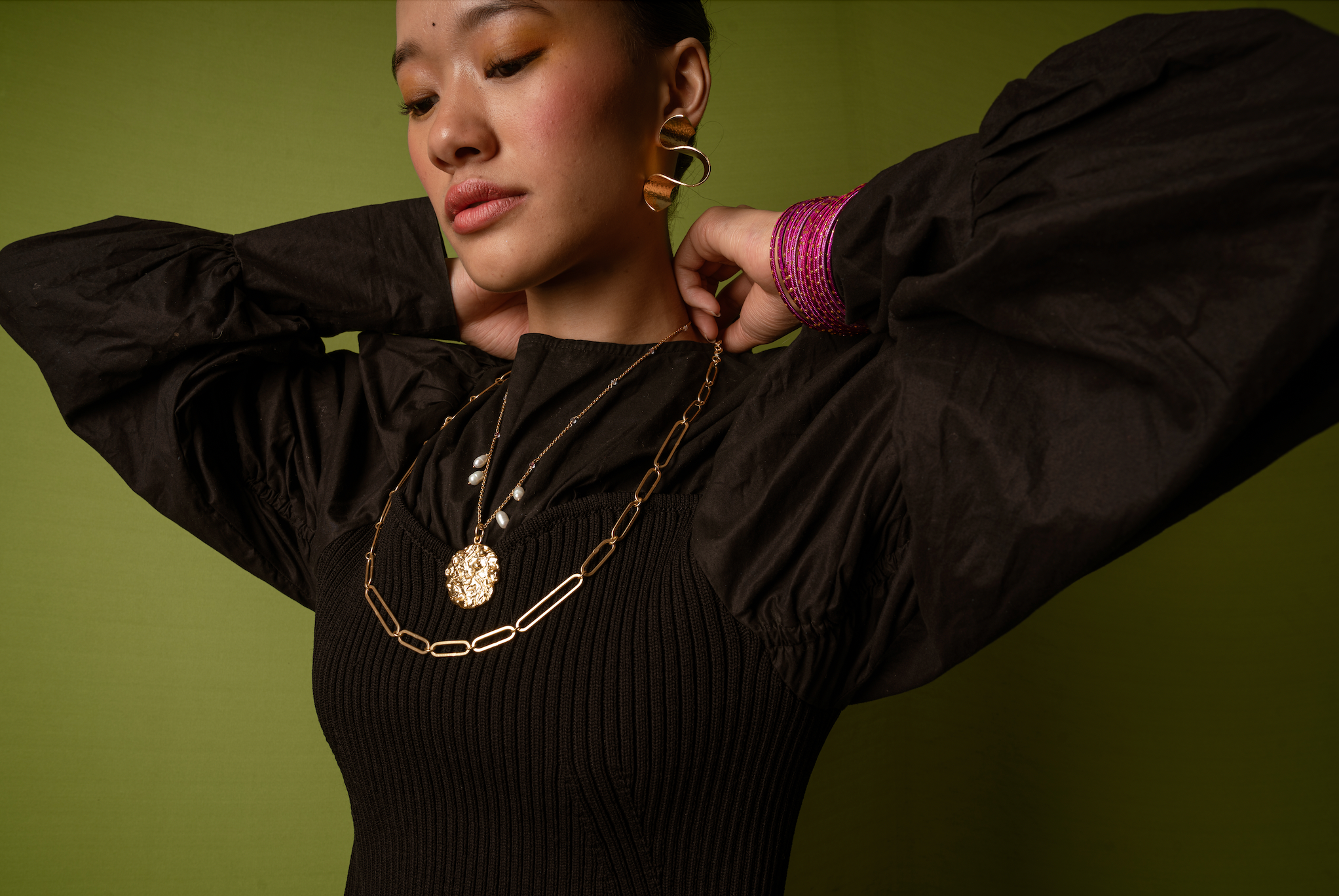
There’s a misconception that gender-neutral jewelry has to look safe, minimal or deliberately anonymous. It doesn't. It can be a massive sculptural earring. A heavy signet. A thread-thin chain. A stack of silver rings. A pearl strand. A chunky bracelet. Something ancient-looking. Something futuristic. Something soft. Something unapologetically bold.
There is no universal aesthetic because being gender-neutral isn't an aesthetic.
It is an approach to design that leaves the wearer out of the assumption. The piece doesn't tell you who you are supposed to be. It lets you decide. And that freedom is what makes the jewelry interesting.
THE PIECES THAT LAST ARE THE PIECES THAT ADAPT
Trends have become faster. Personal style has become more fluid. What you wore five years ago might have nothing to do with what you wear now—and that's exactly why the jewelry worth keeping tends to be the jewelry that can move with you. The chain that works with a white T-shirt and a tailored jacket. The ring you can wear alone or stack with three others. The hoops that survive work, dinner and whatever happens after dinner.
The piece that doesn't need a specific outfit, occasion or identity to make sense. Because the best jewelry doesn't demand that you build your look around it.
It finds its way into whatever version of you shows up that day.
MAYBE THE REAL LUXURY IS CHOICE
For a long time, jewelry came with rules. Rules about what looked appropriate. What looked sophisticated. What looked masculine. What looked feminine. What you were supposed to wear—and where. But there is something more interesting happening now. People are choosing for themselves. They are mixing eras, materials, silhouettes and styles without asking whether the combination makes sense according to someone else's rulebook.
And that might be the most meaningful shift of all. Because removing the gender label doesn't make jewelry less personal.
It makes it more personal.
Once a piece is no longer defined by who should wear it, it can finally be defined by who does.
You.
SO, WHAT ARE YOU WAITING FOR?
Wear the pearls.
Wear the signet.
Wear the tiny ring.
Wear the giant one.
Mix silver with gold. Stack everything. Wear one piece for ten years. Change your mind tomorrow.
There is no correct way to look like yourself. And maybe that's the future of jewelry—not creating more categories, but needing fewer of them. Because jewelry was never really about being a man or a woman. It was about memory. Expression. Identity. Desire.
And the simple, very human feeling of seeing something beautiful and thinking:
I want that.
No label required.